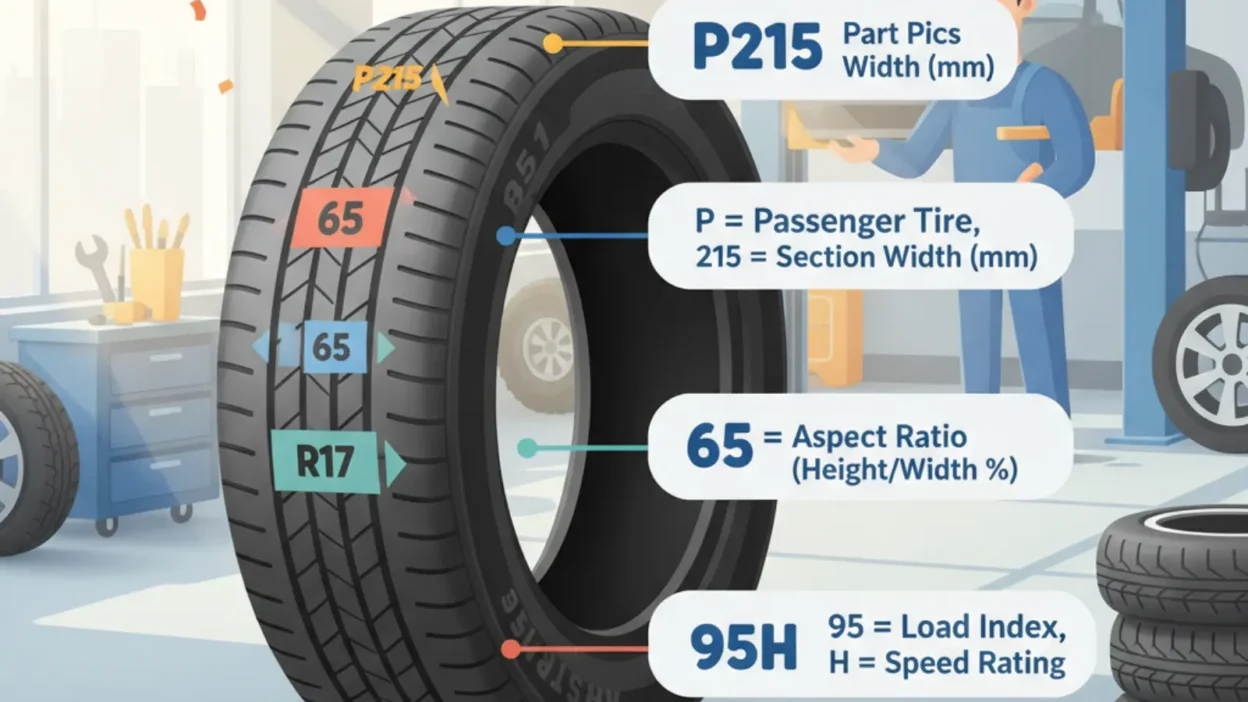
Have you ever looked at the sidewall of your car tire and wondered what all those numbers and letters mean?
From 205/55R16 to 91V, these seemingly random digits are actually packed with information about your tire’s size, load capacity, and performance.
Understanding what the numbers on a tire mean is essential for safe driving, proper maintenance, and ensuring you choose the right tires for your vehicle.
Recently, searches for this topic have spiked as more drivers want to replace or upgrade their tires and need to decode the confusing tire codes.
In simple terms, the numbers on a tire tell you its width, height, construction type, and the size of the wheel it fits, along with load and speed ratings.
Learning to read them can help you make better decisions and drive safely.
⚡ Quick Answer
The numbers on a tire indicate its size, type, load capacity, and speed rating. For example, in the code 205/55R16 91V:
- 205 = tire width in millimeters
- 55 = aspect ratio (height to width)
- R16 = radial construction and wheel diameter in inches
- 91V = load and speed rating
📚 Core Content Sections
In Texting and Messaging
While tires themselves aren’t commonly used in texting, sometimes numbers from tires show up in car-related discussions or jokes:
- Example: “Just swapped to 225/45R17s, feeling like a racecar 🏎️”
- Context matters; tire numbers here are practical, not symbolic.
People might also use numbers humorously to exaggerate size or performance.
In Love and Relationships
Tire numbers generally don’t have a direct romantic meaning, but they can appear in couple conversations when talking about cars or road trips:
- Example: “Bought new tires for our road trip, 215/50R17, can’t wait to hit the highway 🚗❤️”
- Here, the numbers are practical, but they can show shared hobbies or plans, indirectly creating emotional connection.
In Slang and Casual Language
Some car enthusiasts use tire numbers in casual slang to show knowledge or status:
- Saying “rolling on 245s” might imply your car has wider, performance-oriented tires.
- In certain circles, tire numbers can be a subtle way to show off car mods.
On Social Media Platforms (TikTok, Instagram, Snapchat, etc.)
Tire numbers often appear in social media content targeting car lovers and DIY mechanics:
- TikTok: Short clips showing “before and after” tire upgrades with numbers visible.
- Instagram: Captions like “Upgraded to 225/40R18 and ready for summer drives 😎🌞”
- Snapchat: Quick snaps of a car’s tires with numbers highlighted for friends who are car enthusiasts.
They help content reach the right audience, like auto enthusiasts or performance car lovers.
Spiritual or Symbolic Meaning (if applicable)
In general, tire numbers don’t have a spiritual meaning, as they are purely functional codes. However, some people might attach personal significance to numbers that appear in tire sizes, especially if they match a lucky number, date, or numerology preference.
Numerology or Cultural Meaning (if applicable)
Similarly, the numbers themselves can be interpreted in numerology if someone personally assigns meaning to them:
- Example: A tire size like 202/50R17 could be broken down into 2+0+2 = 4, considered stable or grounded in numerology.
- This is not universal but can be a fun personal twist for enthusiasts.
🧠 Examples & Usage
Example 1: A typical tire code: 205/55R16 91V
| Part | Meaning | Example |
| 205 | Tire width in millimeters | 205mm |
| 55 | Aspect ratio (height as % of width) | 55% |
| R16 | Radial construction, wheel diameter 16” | R16 |
| 91V | Load index 91, speed rating V | Max 240 km/h |
Example 2: Social media caption
- “Just got new 245/40R18 tires! Feels like my car can fly 🏎️💨”
- Context shows performance upgrade rather than a literal message.
Example 3: Casual chat with friends
- Friend: “What tires are you running now?”
- You: “225/50R17s – smooth ride, perfect for road trips 🚗”
- Context emphasizes comfort and practicality.
❓ Common Questions Section (FAQ Style)
What does “what do the numbers on a tire mean” really mean?
A: It asks for a breakdown of the tire’s size, type, load capacity, and speed rating, which are all indicated on the sidewall.
Is knowing tire numbers positive or negative?
A: Positive – it helps you choose safe, suitable tires and improves driving confidence.
Is tire information romantic?
A: Not usually. Tire numbers are technical, but they can feature in conversations about shared interests like road trips.
How should someone reply if asked about tire numbers?
A: Keep it simple: mention the size, load, and speed rating, e.g., “I’m running 205/55R16 91V tires.”
🏁 Conclusion
Understanding what the numbers on a tire mean is easier than it looks.
These numbers provide critical information about tire width, height, construction type, load capacity, and speed rating.
Whether for safety, performance, or social car conversations, reading tire codes helps you make informed choices.
Now, the next time you look at your tire, you can confidently decode every number and letter.


