In today’s fast-paced digital world, people often come across terms like suffix while texting, studying, or even scrolling through social media.
But what does suffix really mean, and why is it trending?
Whether you’re a student trying to improve your English, a social media user curious about word usage, or just someone who loves learning new things, understanding suffixes can make your communication more precise and effective.
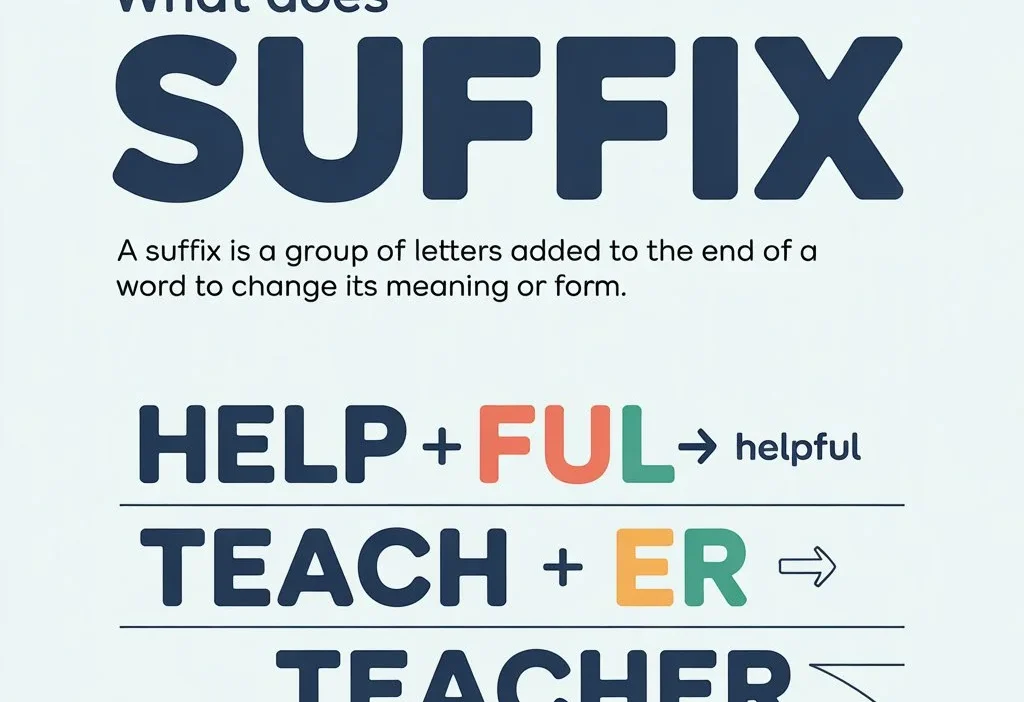
A suffix is a group of letters added to the end of a word to change its meaning or grammatical function.
For example, adding “-ful” to “help” makes it “helpful,” changing it from a verb to an adjective.
⚡ Quick Answer
A suffix is a letter or group of letters added at the end of a word to modify its meaning, tense, or function. It helps create new words or adjust grammar easily.
📚 Meaning of Suffix in Different Contexts
In Texting and Messaging
In texting, the term suffix usually appears when people discuss abbreviations, acronyms, or word endings. For example, in shorthand texting:
- “msg” is short for “message”
- Adding a suffix like “-ing” in “texting” shows ongoing action
Understanding suffixes in texting helps interpret messages quickly and correctly.
In Love and Relationships
Suffixes can subtly influence meaning in romantic language. Words like:
- “lovable” (-able suffix) → someone who can be loved
- “romanticize” (-ize suffix) → to turn something into a romantic notion
Suffixes can transform simple words into terms with emotional or affectionate nuances, making your messages more expressive.
In Slang and Casual Language
Slang often plays with suffixes for emphasis or humor:
- “chillaxing” = chilling + relaxing (-ing suffix)
- “snackable” = attractive or appealing (-able suffix)
These suffixes make casual conversation playful, creative, and trend-driven.
On Social Media Platforms
On platforms like TikTok, Instagram, and Snapchat, suffixes are widely used in captions, hashtags, and trends. Examples:
- “TikTokable” → something worth sharing on TikTok (-able suffix)
- “Inspo-worthy” → inspiring content (-worthy suffix)
Recognizing these suffixes helps users understand trending topics and participate in online conversations.
Spiritual or Symbolic Meaning
Although less common, suffixes can appear in symbolic contexts. Words ending in -ism or -ology indicate belief systems or studies:
- “Buddhism” → a spiritual path
- “Psychology” → the study of the mind
Suffixes help identify the essence or focus of spiritual and philosophical words.
Numerology or Cultural Meaning
In cultural contexts, suffixes can change the meaning of names or terms:
- In Japanese, -ko at the end of a girl’s name (e.g., “Yuriko”) means “child”
- In English, -son or -sen indicates lineage (e.g., “Johnson” = son of John)
These endings carry cultural, historical, or family significance.
🧠 Examples & Usage
Here are some practical examples of suffixes in use:
| Word | Suffix | Meaning Change |
| Happy | -ness | Happiness (noun form) |
| Teach | -er | Teacher (someone who teaches) |
| Care | -ful | Careful (adjective) |
| Run | -ing | Running (present participle/action) |
Texting Example:
- “I’m loving this song!” (-ing suffix shows ongoing action)
Social Media Example:
- “This recipe is totally Instagrammable!” (-able suffix makes it fit the platform trend)
Context Matters:
- “Hopeless” (-less) can sound negative, while “careful” (-ful) is positive. Suffixes shape tone and meaning.
❓ Common Questions About Suffix
What does suffix really mean?
A suffix is a letter or group of letters added to the end of a word to change its meaning, form, or grammatical function.
Is suffix positive or negative?
It depends on the word. Suffixes like -less can sound negative (hopeless), while -ful can be positive (joyful).
Is suffix romantic?
Not inherently, but some suffixes like -able or -ful can enhance affectionate expressions.
How should someone reply to suffix-based slang?
Understand the meaning first; the suffix often indicates mood, action, or trend. You can reply naturally based on context:
- “That’s so Instagrammable!” → “Totally, I’m saving this!”
🏁 Conclusion
A suffix is a simple yet powerful part of language that changes the meaning, tense, or function of a word.
From texting to social media, love notes, or cultural names, suffixes influence communication in subtle but meaningful ways.
By understanding suffixes, you can improve your writing, texting, and online expression, and now you fully understand what this trending term means.

“William focuses on classic and sophisticated anniversary messages that never go out of style.”


